Brief History
Here is the English translation:
History and Development of Janajagriti Secondary School
Janajagriti Secondary School was established in 2037 B.S. through the contribution, participation, and voluntary labor of local social workers, intellectuals, and youth from Jagdol, Ward No. 7 of the then Kapan Village Panchayat. The school initially began its educational journey in a two-room temporary building with the objective of providing literacy and education to children who were deprived of schooling opportunities. Under the chairmanship of social worker Mr. Atmaram Poudel, the school was formally established and operated from 2037 B.S.
Through the initiative of the founding chairperson, the school gradually gained stability and expanded its physical infrastructure in 2041 B.S., enabling the continuation of primary-level education. Today, Janajagriti Secondary School is situated at an elevation of approximately 1,440 meters above sea level, located at 27°44’50.89″ North Latitude and 85°22’35.79″ East Longitude. It lies about 7 kilometers north of the center of Kathmandu, approximately 500 meters north of the National Martyrs Park, at Jagdol Bhanjyang, the junction of Budhanilkantha Municipality Wards 11 and 13 and Gokarneshwor Municipality Ward 3.
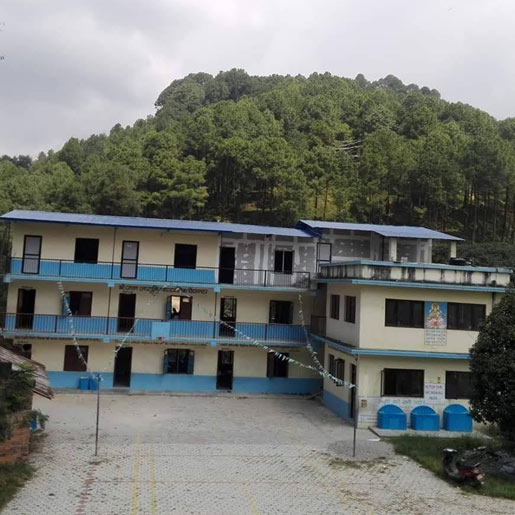
The school occupies approximately four and a half ropanis of public land owned by Budhanilkantha Municipality. It currently consists of three two-storey permanent buildings with a total of 22 rooms, a multipurpose hall, and three commercial shutters. Three rooms are used for administrative purposes, one room serves as the library, one room functions as a canteen, and the remaining rooms are used for regular teaching and learning activities.
The school was upgraded to the lower secondary level in 2053 B.S. and has been providing secondary-level education up to Grade 10 since 2064 B.S. Since 2051 B.S., the school has received significant support from Fulhari Gumba Ananda Sangha, including the construction of two twelve-room permanent buildings, toilets, boundary walls, library facilities, sports equipment, maintenance support, and educational improvement programs.
In addition, the school has benefited from various government and development programs, including grants under the Ministry of Education’s School Physical Improvement Program, the former Ministry of Peace and Reconstruction’s Development for Peace Program, Village Development Committee grants, and post-earthquake reconstruction initiatives undertaken by the National Reconstruction Authority following the devastating earthquake of 2072 B.S. These efforts have significantly transformed the school’s physical infrastructure.
After the Constitution of Nepal 2072 assigned responsibility for secondary education to local governments, Budhanilkantha Municipality has continued to provide direct support for infrastructure development and educational improvement. Under these initiatives, the school has upgraded its furniture, organized its science laboratory, computer laboratory, and library, and introduced Smart Boards in Grades 6, 8, 9, and 10. Early-grade students are taught through play-based methods, while additional classes from Grade 7 onwards have further contributed to improving academic performance and educational quality.
To strengthen the sense of ownership among stakeholders under the spirit of “The School Belongs to Us”, the school has continuously incorporated suggestions, feedback, and support from parents, intellectuals, teachers, and community members. The contributions and leadership of former chairpersons Mahesh Gautam, Trilochan Poudel, and Shyamraja Gautam in advancing educational development are highly appreciated and remembered.
The school provides inclusive and equitable education to children from diverse social, cultural, linguistic, religious, and ethnic backgrounds. It also offers regular scholarships to deserving students. Additional scholarship opportunities are provided through various memorial funds, including the Late Gagan Kumari Memorial Fund, Late Sita Bharati Memorial Fund, Late Teacher Bidya Poudel Memorial Fund, and Late Khadga Keshari Memorial Fund, primarily targeting economically disadvantaged and academically talented students.
With support from Splash Nepal and DLPI, the school has established a purified drinking water system. Separate toilets are available for boys and girls, while disability-friendly and child-friendly toilets are currently under construction. The school compound is fully enclosed with a boundary wall to ensure safety and security.
To support academic excellence, the school has developed facilities including a library, computer laboratory, science laboratory, and audiovisual learning resources. Practical classes are regularly conducted in the science and computer laboratories. For students from Early Childhood Development (ECD) through Grade 3, child-friendly audiovisual learning is delivered through television-based instructional materials. Furthermore, Smart Board technology has been introduced in Grades 6, 8, 9, and 10 to promote digital learning and technology-friendly classrooms.
With the support of Child Nepal, the ECD classrooms have been effectively managed and improved. Midday meals are provided to students across all grade levels. Teacher attendance is managed through an electronic attendance system, and CCTV cameras have been installed throughout the school to monitor all classrooms and ensure effective supervision and security.
Through continuous community support, infrastructure development, technological integration, and a commitment to quality education, Janajagriti Secondary School has established itself as a respected educational institution dedicated to academic excellence and holistic student development.
Activities Photos
Honors & Awards
Physical Structure
Teacher Level/Subject-wise Details
Extra Activities
Student Clubs
Child Club
Eco Club
Classwise Student Details
School Calender
Google Map
Location Information
Fee Structure
Contact